
“Buy the truth and do not sell it.” Proverbs 23:23
If you are listening carefully, you might hear a new word bouncing around the classrooms and hallways of GFA: “commonplacing.” If you have not heard of it yet, then I predict you soon will. We are in the process of providing many of our students with beautiful custom bound and embossed commonplace books, and if your student has not received one this year, then they will in the not-too-distant-future. Look for it!
“As students encounter true, good, and beautiful things in our classes, it should change them and form who they are. What we don’t want are students to encounter truth and then leave it lying by the wayside like something of little value. We want them to treasure it and hold on to it.”
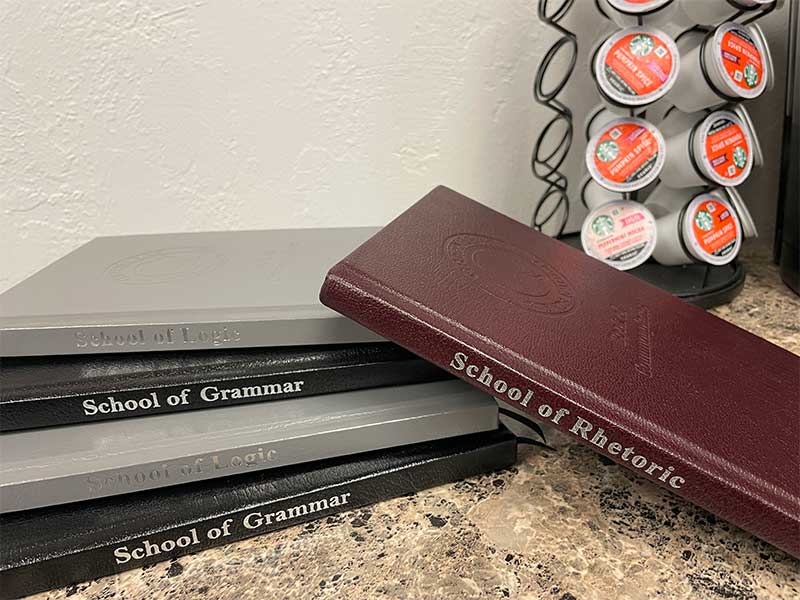
Commonplacing is the practice of writing down in a “common place” – hence the name! – Bible verses, great quotes, passages of literature, hymn lyrics, etc. that a person encounters over a lifetime. The practice is at least 3,000 years old and stretches all the way back to King Solomon; The Book of Proverbs is essentially King Solomon’s commonplace book. Famous people who have kept commonplace books since then include Cicero, Marcus Aurelius, Leonardo DaVinci, John Milton, John Locke, Virginia Woolfe, and Ronald Reagan. To encourage our students to step into the great tradition, GFA has supplied them with beautiful custom hardbound and embossed books complete with the GFA logo and silver leafing.
As students encounter true, good, and beautiful things in our classes, it should change them and form who they are. What we don’t want are students to encounter truth and then leave it lying by the wayside like something of little value. We want them to treasure it and hold on to it. Commonplacing facilitates this by doing four things really well for our students:
- It serves as their memory – By the time our students graduate from GFA, they will have three volumes of handwritten quotes and passages from the great hymns, literature, Bible memory passages, etc., that they have studied while at GFA. They can go back to their commonplace books and find references for a lifetime to refresh their memory, to cite for college papers or conversations, or to use in sermons if they are called into pastoral ministry.
- It increases literacy by demanding active reading – People are busy and have a lot rolling around in their brains: multiple classes, dinner plans, athletic practices and games, etc. The business of life is compounded by the constant ‘bings!’ and ‘buzzes!’ that comes with living in an electronic world with a super computer stowed in our pocket. Commonplacing encourages students to focus on what they are reading as they look for specific passages or quotes to capture.
- It facilitates the memory of key passages and quotes – Studies show that one of the best ways to get an idea or quote from the written page into the heart and mind is by the painstaking process of attending to it by breaking it down into its individual clauses while copying from one place to another. This is then amplified as students continue to interact with the passage over and over again: in conversation, on exams, in essays, etc.
- It increases reading comprehension – When they encounter a key quote or passage, students have to slow down and think about what is being said. GFA commonplaces are organized topically by virtues and great ideas such as “Love,” “Community and Fellowship,” “Light vs. Darkness,” and “Death and Eternity.” When students come into contact with something commonplacable, they have to ask themselves important questions: What point is the author making? How does it fit into both this text and the overall canon of great literature and ideas? How might the passage shape or change me? After answering some of these basic questions, students then pick a topic to categorize their quote under. Over time, this effectively brings the greatest authors from the centuries into conversation with one another; for example, by the time a book is full, students might have quotes from authors such as Moses, Homer, The Apostle Paul, Virgil, Dante, Milton, Austen, Shakespeare, and C.S. Lewis all on the same page discussing formative topics such as faith, love, glory and honor, community and fellowship, etc. In summary, one of the Desired Outcomes for a GFA Graduate that we discussed a few weeks ago is “Literacy with a broad exposure to books and ideas.” Commonplacing is one of the most important programs we have to accomplish this outcome and to produce students who are lifetime learners. It is our hope that GFA graduates will then go out into the world equipped to share the good news of the gospel with anyone God places in their path by leveraging the great ideas and timeless passages they encountered while at GFA.
“Over time, [commonplacing] effectively brings the greatest authors from the centuries into conversation with one another; for example, by the time a book is full, students might have quotes from authors such as Moses, Homer, The Apostle Paul, Virgil, Dante, Milton, Austen, Shakespeare, and C.S. Lewis all on the same page discussing formative topics such as faith, love, glory and honor, community and fellowship, etc.”