
“We must [not] try to keep out of [our student’s] mind the knowledge that he is born into a world of death, violence, wounds, adventure, heroism and cowardice, good and evil…. Since it is so likely [our children] will meet cruel enemies, let them at least have heard of brave knights and heroic courage. Otherwise, you are making their destiny not brighter but darker.” C.S. Lewis
This is the fourth installment of our series on the six characteristics our school board has identified as being the most important characteristics we hope our alumni leave our school with, called the “Desired Outcomes of GFA Graduates.” The first three outcomes we discussed were a sound reason and a sound faith, virtue and mature Christian character, and a masterful command of language. This week we move on to our fourth Desired Outcome: literacy with a broad exposure to books and ideas.
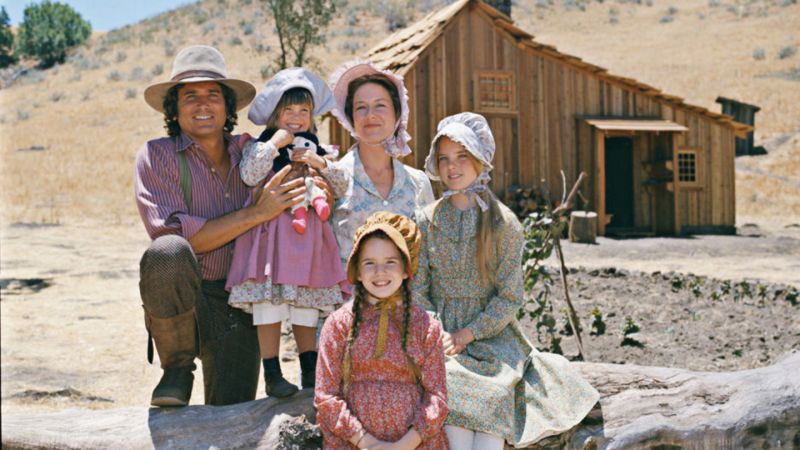
The Ingalls Family from “Little House on the Prairie.”
“We should be less concerned with what stories entertain students, and more concerned with what stories transform them.”
I surprised my sophomore students this week when I told them they were getting a college level class. We had already read Homer’s Iliad and The Apology of Socrates by Plato, and we are nearly finished with Sophocles’ Antigone. All are titles that most high schools have given up as being too difficult, irrelevant, or antiquated, and yet we at GFA continue to read them. Is this wise? Wouldn’t we be better off reading books that are more accessible to students, and that they actually enjoy?
I recently had an article published in The Classical Difference Magazine that answers some of these questions. In it I discussed a recent Wall Street Journal article that looked at a tech company’s algorithms that showed what kind of stories kids enjoy reading; predictably, ninjas and talking dinosaurs were high on the list, while substitutionary atonement and ethical philosophy were not. The thrust of the article is that the tech company involved is trying to determine what kind of stories entertain kids; as Christian parents and teachers, I argue that we should be less concerned with what stories entertain students, and more concerned with what stories transform them. As Dr. Albert Mohler of the Southern Baptist Theological Seminary put it, “”if we just give children what the algorithms say they want, they’re going to miss an awful lot of literature, including exposure to those creatures, those stories, those persons, those narratives that they do not yet know that they want.”
As Christians, it is important that we not buy into the relativistic worldview of the culture that tries to tell us that there is nothing more true, good, or beautiful than another thing, that all evaluations are only relative or dependent on what an individual person might think about a thing. It is true that there might be some things that fall into this relative category; for example, I don’t know that vanilla ice cream is any better than chocolate, or that the color blue is any better than the color red. However, we know that there are some things in life that are better than other things: the Bible is more true than the Harry Potter series; the constitutional republic of the United States is better than the totalitarian government of North Korea; the hymn “It is Well With My Soul” is more good than whatever random song current pop culture musicians are producing. This is also true of the books our students read. We want to put the best books in front of them, those books that have stood the test of time and have proven themselves to contain timeless ideas, that are full of true, good, and beautiful themes, images, and language.
Finally, there is one more important point to be made: great books have the ability to shape who we are. Let me give you a couple of examples. First, if I were to score myself as a dad, I would give myself a solid B+ (I’m trying to get that grade up!), but I had a realization later in life that I didn’t learn how to be a good father from my own dad. I came from a broken home that had some dysfunction; instead, I had awakened in me a vision for being a good father by growing up watching the TV series “Little House on the Prairie.” As a ten year old boy, I wanted to grow up and be Charles Ingalls. Great stories have the ability to form what philosophers have termed a “moral imagination” in our students – that is, a sense of the way the world should be, not the way the world is. Second, great books have the power to help us understand things about ourselves and the world in which we live; for example, I had a sophomore student tell our class last year that Augustine’s idea of virtue as “rightly ordered affections”, or ordo amoris in Latin, literally changed the way she saw the world: it helped her to understand just about everything that is right and wrong in the world. The world functions as God intended when we love things in the right order – e.g. God, family, neighbors, etc. – and life becomes dysfunctional when we love things out of order.
As our basketball coach likes to say, “Nothing worth doing is easy.” This certainly applies to the books and ideas we expect our students to engage with: they are not easy by any stretch of the imagination, but they are worth the effort.